Friday, 19 April 2013

Diamonds in the Dirt


Great crested newts are significantly larger than the small smooth newt, here two females can be seen side by side.

In some of Britain's ponds there lies an almost mythical creature, a creature who's name is known to many, yet few have ever actually seen it. A shy, retiring, nocturnal creature which is right up there with Britain's most iconic species. This is the great crested newt an absolute giant when compared with our other newts, the smooth newt and palmate newt. In fact great crested are so much larger, that the two smaller species occasionally become a light snack. Great crested newts are our most striking amphibian, a large black (or dark brown/green) salamander like newt, with a bright orange/yellow marked underside. The male has a well developed crest and bright flash along the centre of the tail (during the breeding season). Female crested newts occasionally reach 16cm making them just about our largest native amphibian.

A male (bottom) and female (top) during their terrestrial phase, not the pale line on the males tail. The female has a orange/yellow base to the tail which the male lacks. 

Britain supports a significant proportion of the European population, making it an important stronghold for the species. This leads to one of the reasons for the species notoriety as it is protected by European law (as well as British). The species has quite specific habitat requirements and is less of a pioneer in comparison to common frog and smooth newt. The preference for large-medium, mature, moderately  vegetated, ponds, with open lecking areas and a reasonable depth with no fish, means populations can quickly stop producing if these factors change or such ponds are lost. Hence why the species like most of our amphibians have declined over the past century, but perhaps at the most rapid rate than any of the other species of reptile or amphibian and a further reason for its high level of protection.

The underside of a female crested newt, showing the orange/yellow tail base and markings of the belly and throat. Each marking on the underside is unique to the animal like a finger print. 

Great crested newts are typically a lowland species (although I did curiously find one in a small valley in raised moorland a number of years ago) which occupies hard, circumneutral water. As mentioned the species have a clear preference for large mature ,well vegetated ponds which do not contain fish, especially where these exist in clusters and meta-populations (a group of interlinked populations) can exist. If one pond is lost the meta-population remains in the area. Terrestrial habitat is also important where it surrounds ponds and links ponds together with a preference for hedgerows, woodland, scrub and rough grassland. As woodland progresses to climax and has more fallen deadwood it generally becomes better. These newts are perhaps our most aquatic amphibian species but when on land occupy voids between tree roots, rotten stumps, disused small mammal burrows, rubble piles and similar habitats with dry, frost free, tight gaps in which they can squeeze themselves (they like to be secure).

By their 1st spring juvenile great crested newts are almost the same size as smooth newts. 

Like our other amphibians great crested newts hibernate over the winter and generally start to return to ponds from as early as February. A catalyst of damp nights above 5oC tends to spark migration to the breeding pond (most adults hibernate within 500 metres of this). Males tend to arrive at ponds slightly earlier than females, a pond I looked at last night had about 90% of males out of 35 individuals, possibly as a result of this. Crested newts are far more nocturnal than our other amphibians and also tend to be more benthic (bottom dwelling) and are only occasionally seen during the day, which probably results in so few people seeing them. They tend to leave the pond over a protracted period between May and September, with males often leaving first.  

Great crested newts are also known as warty newts due to their rough skin. 

Breeding courtship is an elaborate activity, with a lot of tail waggling and dancing, which ultimately results in external fertilisation. Once fertilized the female lays between 250-300 eggs individually within aquatic vegetation, carefully folding each egg. Favoured egg laying plants include water-forget-me-not (about the best plant for these newts), water cress, water speedwell, floating sweet grass, water mint and great willowherb. Interestingly due to a genetic defect (development arrest syndrome) about 50% off all eggs in every population abort around the early "tailbud" stage. It remains a evolutionary mystery as to why a species has evolved such a wasteful means of reproduction.

A water forget-me-not showing a typical great crested newt egg fold (centre of the picture). 

As mentioned earlier adult smooth newts are periodically taken, however the diet largely consists of water bugs, beetles, leeches, worms and tadpoles. Terrestrial prey is similar and as a generalist almost any invertebrate (or vertebrate) which fits in the mouth is eaten. Great crested newts use both vision and electric impulses to locate their prey. Foraging usually occurs during the night, when few predators are around.

I am a licensed great crested newt ecologist and all photographs were therefore taken legally. It is an offence to disturb, catch or handle, this species unless it is in immediate danger, without a Natural England license. All photos taken with a compact camera whilst working. Like many of the YETI posts it is a quick overview and I will try to revisit this species and take a more detailed look at its ecology.  


Tuesday, 16 April 2013

What Lies Beneath


2013 appears to be a fantastic toad year, with ponds across the region brimming with them. 

If you have any spare time over the next few days why not go and visit your local pond, chances are you will be greeted by an abundance of common toads, a true spectacle of British springtime. Toads might not have the charm of the first swallow or the beauty of blooming primroses but they are indeed an equal even within natures calendar.  Toads have returned to ponds in such good numbers this year,  that in the past twenty four hours, from the time of posting this, I have counted over 1,500 adults in ponds across the recording area. Toads breed en-masse and the sudden warmth we have seen over the past 5 days has sparked this nuptial migration into life. A creature perhaps misunderstood with historical associations with the devil and witchcraft, in reality toads are characters and rather docile creatures. However they do have another less well known darker side. 

Its was once believe that toads possessed a jewel within their head which gave them their bright gold eyes. 

Common toads are probably the least aquatic of our native amphibians and only enter their breeding ponds for an extremely short period of time during the spring. Almost the entire breeding population within a given area enters the pond over a short (usually 48 hour) period, if favourable weather conditions persist. Animals average about 50 metres per day whilst on migration to the pond. When toads have finished breeding they disperse widely upto 2km into the surrounding area over the summer, before migrating back towards the pond in the autumn (shortening the effort required during the spring).

Male common toads, sit near the surface of the pond waiting to pounce of a female, they occasionally get it wrong and grab frogs as well as fish. 

Common toads favour hibernation sites within unused small mammal burrows (i.e. woodmouse, bank vole and brown rat). Hibernation persists until night time temperatures reach 5-6 oC, most migration also coincides with night time rainfall, when the animals are less prone to desiccation. Toads are primarily nocturnal in their ecology and most breeding activity, migration and foraging occurs at night, especially in the first two hours after dusk.


The spawing period is highly impressive and usually occurs after that of the frogs. Large numbers of animals congregate at communal spawning ponds at this time. These populations tend to be heavily male dominated owing to males reaching sexual maturity more quickly, arriving at the ponds earlier and spending more time in the pond of the breeding period. Males usually outnumber females considerable (anywhere between 2 and 10 to 1). Females are therefore in high demand from the masses of amorous  males and are quickly seized (often before they even get to the pond). This leads to the embrace known as amplexus in which the male clasps onto the female from behind her arms. Fertilization is external and the stimulation of the females eggs passing over the males hind legs causes him to release sperm and fertilize them as they are released from the female.

The males, muscular arms are used for clasping females and wrestling other males, toads are amazingly strong creatures for their size. 

If it was only this simple though... the large numbers of males results in rather aggressive (as toads go) competition for females. Whilst a pair are in amplexus other males will try to wrestle them apart and mate with the female themselves. This results in TOAD BALLS!!!! in which a mass of toads are found clasped, wrestling together around a poor female, which can occasionally drown or be crushed. This behaviour is perhaps an evolutionary means for larger stronger males to displace weaker smaller males from females and pass on his genes. Certainly an entertaining event to look out for at the local pond. This fighting, toad behaviour is used in the common toad rather than vocal calls (as we see with natterjack). However toads still do call, the call is a high pitched squeak rather than the deep croak of the common frog.   

A toad ball, which probably contains a female buried in the middle. 

Toads (like frogs) do not feed until breeding is completed, which can put pressure on animals, resulting on natural losses during the spring. Animals which do survive forage on invertebrates like beetles, earwigs, spiders as well as molluscs and worms. Toads will also feed on other amphibians, like young smooth newts, common frogs and other toads, occasionally baby small mammals are taken from nests, as are the nestlings of ground nesting birds. Neither of the latter two feature heavily in the diet. 


Thursday, 11 April 2013

Addicted to Acid


Palmate Newts are one of our most overlooked amphibians, perhaps due to their secretive ecology and small size.

No Not Me!!!!, but today's featured creature is very much a characteristic of the small moorland pools within the region. This is the Palmate Newt, perhaps the species of newt most out of the public spotlight in Britain, unlike the notorious great crested newt, or the common garden dweller the smooth newt. Palmate newts predominantly occur away from settlements and often in quite remote places like heaths, woodland and moors. Palmate newts show a clear preference to soft water with a low pH (acidic) high in potassium and sodium, in comparison to both the crested and smooth which are usually found away from acidic waters, so much is the case of the former that breeding productivity is significantly reduced in such waters.


 Like other amphibians Palmate Newts have moist permeable skin. 

Palmate newts are our smallest amphibian and are well and truly dwarfed by the larger great crested newt. A small rather rotund newt which is not to dissimilar from its close relative the smooth newt in both appearance and biology. Breeding occurs during the spring (Feb-April) like our other amphibians, with males arriving in the pond slightly earlier than females (I had one in a pond in January this year). It's certainly not unusual to find palmate newts in ponds during the winter, although most migrate during the spring on mild damp nights.

A male palmate newt, might not be quite in the same league as smooth and crested newts when it come to breeding decor, but they are still interesting looking creatures.  

Palmate newts like smooth newts are less aquatic and less nocturnal than crested newts, however daytime is nonetheless usually spent in the cover of aquatic plants or debris in the ponds base. As dusk falls these newts move from their hiding places into open parts of the pond to undertake courtship and mate. This activity follows a crepuscular pattern with peaks in activity at dawn and dusk, I find palmate slightly intermediate between smooth who are often diurnal and rested which are usually nocturnal.

Male Palmate Newts show palmated hind feet, a filament on the tail tip, and only a small crest along the tail. 

Similar to the other two species, female Palmates lay between 200-300 eggs, each is individually wrapped in a submerged leaf. Newts usually use aquatic plants, but overhanging vegetation, grass, flooded terrestrial areas and even discarded litter can be used. Palmate newts tend to be slightly more lazy when it comes to wrapping eggs and occasionally don't bother, or do a quite poor job of it, quite unlike the female great crested newt which will meticulously wrap every egg with great care. Great diving beetles are one of the biggest threats to newt eggs (of all species) and feed on wrapped and unwrapped eggs. Egg laying tends to extend from March until June, sometimes later owing to cold spring weather (as we will no doubt see in 2013).

Palmate Newt often have more heavily marked faces than smooth newts. 

The protraction of newt egg laying unlike anurans (frogs and toads) means that you get a whole mixture of different aged larvae within the pond at a given time. This often means larvae which are late to hatch will overwinter within the pond and emerge the following year. Certainly something which I have come across regularly dipping palmate ponds in the winter for invertebrates. Although palmate newts do develop faster than smooth newts and later hatching larvae appear to develop a lot more quickly than early ones, possibly owing to a more developed prey community later in the summer.     

The past week has seen a huge influx of mating frogs and spawn is now present in most ponds across the region. 

Poached, Scrambled, fried or boiled palmate newts feed voraciously on frog eggs. Here the tail of a feeding male can be seen.  

Prey largely consists of small aquatic invertebrates including freshwater shrimp, hoglice, zooplankton. Similarly they feed largely on invertebrates during their terrestrial phase, focusing largely on small soil dwelling creatures like mites and springtails.

Another feature of palmate newts (males and females) is the almost translucent pink throat, which tends to lack the spots of smooth newts, smooth newts show a more cream/yellow throat. 

As well as palmate newt regular sightings of goshawk over the forests has been a pleasure to watch, including a male chasing a woodcock (until beyond view). The rivers seem to be thriving with bird life, the local grey wagtails, dippers, kingfishers are all getting broody. I also managed my first bat of the year in the form of a Pipistrelle, unfortunately it was in the middle of the afternoon and I didn't have a detector. Identification to species (most likely either common or soprano) is impossible from a view of a flying individual like this. This individual has either been disturbed or forced to feed during the day due to poor weather conditions. Waking during hibernation is quite normal for this species, which is well adapted to cope with warm spells. In fact pipistrelles are too small to put on enough fat to survive hibernation, without additional supplimentary winter feeding.  Small tortoiseshell, the beefly Bombylius major, the bumblebees Bombus terrestris and B.lucorum, the bee Andrena clarkella, and green tiger beetle were all recorded.

Female Grey Wagtail

Female Goshawk

Dipper collecting nesting material

Dogs Mercury is now abundant across the region. 

Gorse is starting to flower

Hazel

Sunday, 7 April 2013

Vibrant Vipers (Part 1, Spring Males).


Adders are one of the most charismatic members of our fauna. 

There can be few species which reside in the British countryside that are more stunning than the adder. This rather stocky little viper has a history steeped in superstition and ignorance, when really it is an absolute privilege to share time with. Adders like most species keep themselves to themselves and their paths seldom cross with those of humans. Noisy footfall and dogs do not interest adders in the slightest, the first sense of danger and the characteristic zig-zag slides away into a crevice not to be seen until danger has passed. Hardly worthy of the hysteria some people appear to get when they see one.

Adders are perfectly adapted to slithering under objects and into gaps and cracks, leading to the old English term creeping thing.  

One of the first questions which is often asked is why such a strange and seemingly un-associated name. The name adder is actually derived from the "Old English" word Naedre which means creeping thing. This eventually evolved into Nadder and again presumably for simplicity into Adder.

Adders are small snakes, despite photographs often making them look large, males seldom reach 60cm in length, with females being slightly longer. Proportionately females are more chunky, with shorter tails (interestingly snakes do have tails), females tend to be more brown in colour, especially along the zig-zag. Males tend to be more of a silvery grey colour with black zig-zags and a slimmer profile with a longer tail. Pre-shed (like the chap in the photos), the scales are old and faded becoming more of a grey/brown colour, eventually the eye will cloud up and the skin will be removed.

Adders spend large amounts of their time basking during early spring. 

Spring is an important time in the annual cycle of adders and much basking takes place, especially by the males. Males emerge upto a month before females and bask and bask and bask. . . . . . the reason behind this is to aid spermatogenesis (sperm production), as we saw with the common lizard. At this time of year male adders are extremely sedentary and tend to stay close to the hibernaculum. Adders are absolute experts at basking and regularly alter their body position to match that of the sun over the course of the day, they also adopt different basking strategies (i.e. coiled uncoiled) to match the temperature and how much they need to warm up. They have an amazing ability to flatten their body, increasing the surface to sun-exposure. Basking adders often do so with their eyes hidden behind a blade of grass or similar, as their eyes are quite vulnerable to the sun, which can make photography frustrating at times.

Adders can flatten their body, much more so than the one in the photo, to absorb sunlight. 

Once males are ready to mate they slough (shed their skin) unveiling a striking silver and black creature. Around this time females emerge from their hibernacula and those which are ready to mate (most females often only mate once every two years) release a pheromone, which trails along the ground as they move. Adders have a fantastic sense of smell, the tongue catches scent particles and runs them along what is known as the Jacobson's organ in the roof of the mouth. Once the female is found then courtship and mating may occur (hopefully to be covered later in the year).

Throughout the winter hibernation through until the spring, until mating has occurred, the male adder will not feed. All of his energy is from fat reserves put on over the autumn and summer of the previous year. Snakes unlike mammals are cold blooded and subsequently do not need to feed as much as no food is expended on warming up the body (as much as 90% of food is used in this way in mammals). This is perhaps a more efficient way of living, just with the slight inability to be active in cold conditions. An adult adder will feed on between 5 and 10 prey items per-year. Usual prey is made up of small mammals, particularly field voles, woodmice, lizards, birds and nestlings. Younger adders tend to initially feed on young mammals and amphibians.


The adder has a fierce expression owing to the brow, dark red eye and vertical pupil, however they are much understood and placid creatures. 

Without getting carried away and writing a book (it's so easy with this species), I will try and break it down over the year and see what we find.  Hopefully we will find some females and have a part two.     

Thursday, 4 April 2013

A Pause in Diapause


Common Lizards are currently the most abundant herptile, showing just how well adapted they are at coping with cool weather. 

Whilst we are not exactly falling over butterflies and bumblebees waking from their winter hibernation or seeing swarms of bats and packs of hedgehogs, as each days passes we are slowly starting to see more and more creatures and slowly chip away at the YETI's audacious 3,000 species target. When I say slowly I mean slowly, in fact 3 species but they all count and two of these are really indistinct species. As much as I want to be able to post full frame shots of sand martins and wheatears returning to their summer breeding grounds, we are going to have to hold on a little longer. 

A Common Groundhopper,in its green form, amongst the larch needles in a North Yorkshire plantation. 

If we are going to manage 3,000 species its really going to come down to invertebrates and plants, such is the diversity of the first group that you could get 3,000 species in the recording area without seeing a single bird, mammal, amphibian or reptile. Impressive, but it makes identification an absolute mine field. The first species found is theoretically easy enough to identify. This is the common groundhopper Tetrix undulata one of two species found within this region (the other being slender groundhopper Tetrix subulata). As can be seen this is a smaller relative of the grasshopper, with perhaps more robust proportions. Unlike any of our native grasshoppers these two species can be found throughout the year. 

The Brown form of the Common Groundhopper, this species comes in a wide variety of colours.

Common groundhoppers do not sing (stridulate) like grasshoppers so are completely silent. The best way to find them is to look for small bouncing objects at your feet as you move through vegetation in suitable habitat. Common groundhoppers lay their eggs directly into the ground or in low growing vegetation, these hatch during the spring and early summer and go through 6 nymphal stages before  becoming adults. Like grasshoppers groundhoppers are herbivores and this species feeds on a range of mosses and lichens during the day. Habitat typically comprises of dry or damp heath and woodland edge habitats in this region. Interestingly groundhoppers are quite good swimmers too. 

Dorytomus taeniatus showing the typical large nosed alien weevil appearance. 

The other two species are both (tiny c.5mm) beetles and both relatively uninteresting in terms of their life histories. One is a weevil (Curculionoidea) called Dorytomus taeniatus and the second a leaf beetle  (Chrysomelidae) called  Lochmaea suturalis. With so many species beetles tend not to do common names. The weevil is associated with willows particularly smaller sallow species like goat willow and grey willow. The leaf beetle is also associated with heather. I'm sure I am not the only one that finds weevils amazing looking creatures somewhere between a weird alien and a medieval plague doctor. The importance of such seemingly trivial species should not be overlooked as it is the larvae and adults of these kinds of species which ultimately form important early links within food-webs. As a naturalist I have always been fascinated with niches and how different species groups fit together, which has probably resulted in my inability to specialise.

A quite dark Lochmaea suturalis, a species of leaf beetle commonly found on heather.

In addition it was nice to find some frogspawn, the first I have come across this year. Undoubtedly even with the cold weather there will have been earlier laying dates than this. No such luck with adders yet though, however I have only really checked one site, the more low-lying hibernaculum will be checked over the weekend and hopefully will yield much better results. The temperature is still struggling to get above 6oC, we really look at 8oC to 16oC to observe basking adders. 

Frogspawn (photo from 2012). 

Regardless there remains plenty of common lizard activity and the now maturing spiderlings, both of these keep providing me with more photography practice.    

Common lizard (AGAIN!!!!)

Garden or Cross spider Araneus diadematus, after leaving a crack in a fence post, a typical overwintering location.  

Tuesday, 2 April 2013

Enter the Dragon


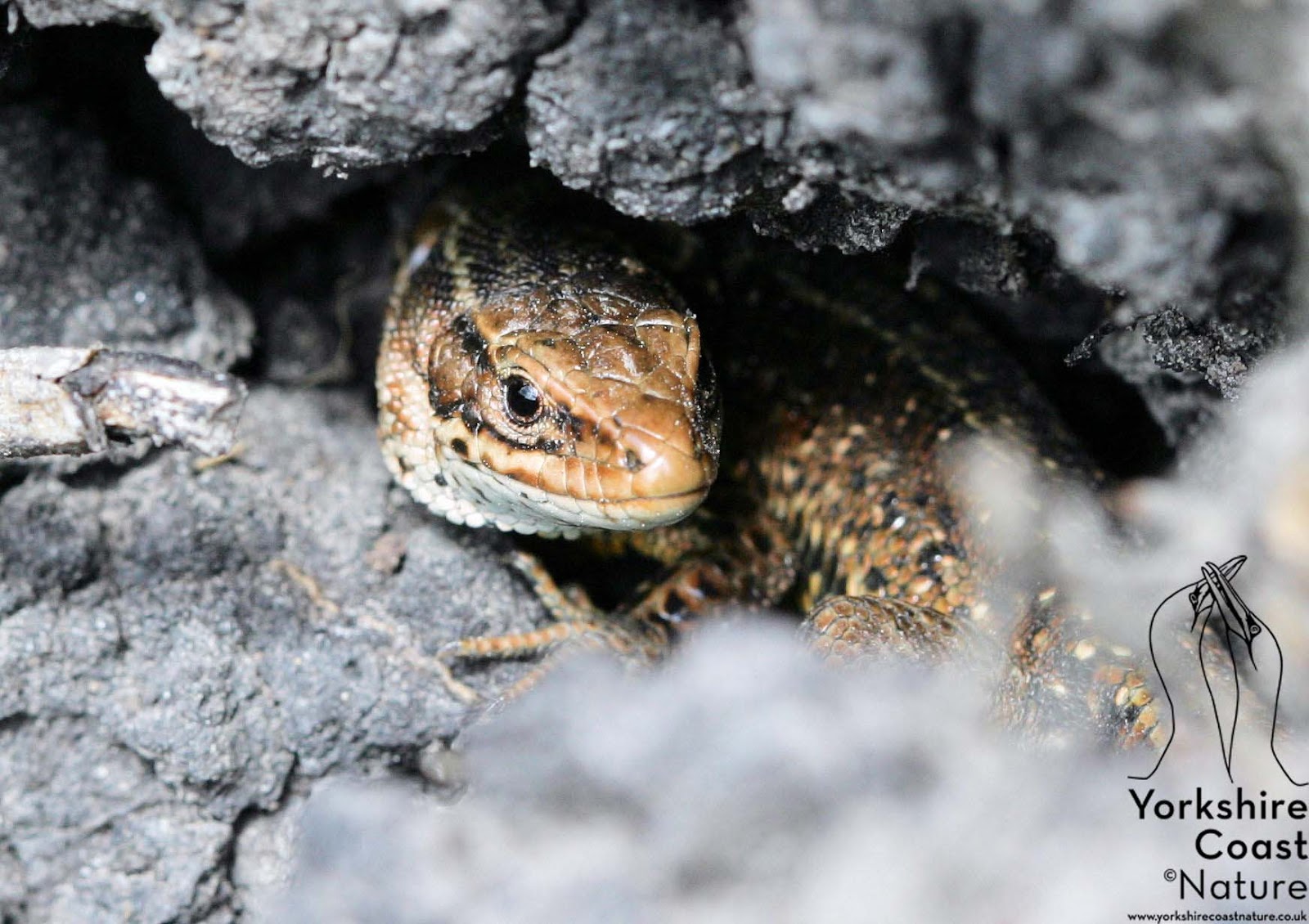
Its been a long winter, but finally we are starting to have some creative fun. A dreary eyed common lizard emerges from hibernation. 

It's been a long, almost everlasting winter, but finally it appears that spring is starting to gain back some dignity. As much as I like the large numbers of wintering birds and more observable mammals winter can drag on a little too much, especially when you are doing a challenge like this and you just want to get on with it. To have a realistic chance of rattling up the magical 3,000 species mark we need plenty of sun, plants and insects. Sun = fun, to me at least, as sun often means reptiles, especially on these cool spring days and there are few species groups (if any) that I like more than reptiles. We are fortunate to have four native species within the recording area boundary the Slow worm, adder, grass snake and common lizard. Hopefully we will get plenty of opportunity to take a look at each of these species in detail. Today let's take a closer look the common lizard.

Male common lizards have bright undersides, which are vibrant orange during the breeding season, this is just starting to show here. 

Although I first recorded the species back in early March, the species has become notably more active and abundant over the past week with the slight rise in temperature and reduced cloud cover. The common or viviparous (owing to it having live young in Britain) lizard generally starts to rouse from hibernation around February, with March perhaps a more usual time in Yorkshire. However common lizards are one of the most cold-tolerant (and widespread) reptiles in the entire world, with populations extending into the arctic circle. Basking is typically in sunny, south facing, locations, close to cover. I find these early emergers often bask in the mouth of the hibernaculum (area used to hibernate) or remain close to cover, to reduce the risk of sudden changes in temperature catching them off guard. As the year draws on they become far more nomadic. The same can be said about how they approach a given day with longer basking in the morning, with regular short feeding trips, these trips become longer and over a longer distance as the day goes on until eventually basking may cease for a period in favour of pure hunting.

Common lizards have well developed hearing and good sight, so if you want to get this close you need to be quiet and move slowly. 

Emergence in the spring occurs when the lizard has attained a core body temperature of around 15oC in the hibernaculum, this is doubled when basking, to allow an operating temperature of approximately 30oC. In spring males need to bask to complete spermatogenesis (sperm production), so a lot of time is dedicated to this, as it is in our other male reptiles at this time. The low surface to air ratio of the body often means they emerge before the adders, with which they often share their habitat. Interestingly females need to undertake a period of hibernation below 8-10oC in Britain, lasting at least two weeks to allow ovarian growth, without this breeding is largely unsuccessful (warm winters are quite damaging for our wildlife in general). Basking is short lived in the summer, but in the spring and autumn we get a good opportunity to get a close look at this rather shy and retiring creature. If you do disturb a common lizard, just sit quiet and wait as they will often move to the same basking location some minutes later.

Lizards are well developed predators, with a large mouth, despite their small size.

Common lizards feed on a wide variety of invertebrates, I managed to observe one feeding on one of the numerous small spiders which are also waking from hibernation, earlier. Typical food includes insects (adults and larvae), centipedes, harvestmen and spiders, small worms, snails and grasshoppers. These prey items are largely detected by sight and sound (be quiet around lizards unlike snakes, who don't have ears). These lizards will often rapidly shake prey to kill it, before swallowing it whole. The mouth is filled with tiny back facing teeth. Although lizards do not bite people, they are very fragile so don't attempt to capture them unless absolutely necessary.

Not everybody likes spiders (I love them), but have some sympathy as just about everything feeds on them. Sub-adult Araneus diadematus.

Common lizards tend to occupy cracks, gaps, small mammal burrows, logs and rocks when they are not active. This one (pictured) was found in the root-ball of a fallen tree. Common lizards do not burrow and are poorly adapted for such activity, in comparison to some of the other lizards. They require features like these to escape their many predators which include corvids (crows), kestrels, common buzzards, hedgehogs, adders (more so smooth snake in southern Britain) and occasionally rats, weasels and even shrews. Unfortunately red-backed shrikes are extremely rare as a breeding bird in Britain but they will also frequently predate common lizards (there's plenty to go around up here guys). Life expectancy varies between lizard populations but 4-5 years is often about right, with 12 years being exceptional.

The base of the tail (just above the blurred root) shows what is known as the penal bulge, this is a good way of sexing males, if your struggling with the other features (not mentioned in the blog post). 

Common lizards are typically found around heathland, moorland and open woodland with less intensively farmed parts of North Yorkshire having about the best populations in the recording area. Common lizards are a local species (the common part of the name is in reference to commons, not the species status), with roadside verges, uncultivated field edges, coastal sand dunes, brownfield sites and cliff edges also used. Common lizards like habitat with a diversity of structure, i.e. different vegetation heights, logs, embankments, depressions. We also see a clear preference for water and humidity, with damp upland grasslands being particularly productive locally. These are insect rich and when close to raised dray habitat suitable for hibernation and loafing can be really productive.     
          
With no undue disturbance this chap was left to get on with his sunbathing. 

It was also good to find a tawny owl pellet close to the lizard, this can be compared with the pellets (barn owl, short eared owl and common buzzard) in the silent spirit post. The pellet was made up exclusively of bank vole a common component of the diet, as seen by the rusty red/grey fur in the pellet. 

Saturday, 30 March 2013

Denizens of Decay


 A closer than normal view of a woodlouse's face, showing the simple clustered eyes. 

Beyond the busy and considerably important boundaries of the human world, there exists a hidden army. An army which is largely so insignificant and neglected that it is often only noticed when one of its ranks breaks and runs across the lounge carpet. This group of organisms is pivotal to the natural world in which we all enjoy and is as essential to the noctule bat roosting in the veteran oak as it is to the bumblebee pollinating the foxglove, growing at the trees base. Decomposition is natures answer to putting your glass bottles, empty cans and cardboard boxes in a blue bin and waving goodbye (not literally I hope). The list of organisms which help in decomposition is impressive and ranges from fungi to fruit flies. They are so important to ecosystems that earth would probably not contain life without them. Essentially they recycle dead matter and turn it into nutrients which support the food webs we are more familiar with.

Slugs perform an important role within ecosystems and are not just an unwanted garden pest.  

Two groups of decomposers can be quite easily found in and around the house (well maybe not one of them unless you have a very damp house), these are the woodlouse and the slug, yes slug, they don't just eat all of your favourite garden plants.

Woodlice are perfectly adapted to living in tight gaps and a life feeding on decaying organic matter. 

Take the woodlouse as an example, evolutionary perfection or a common creature of insignificance? Woodlice live under bark, logs, stones and rocks and typically feed on decaying leaves, bark, fruit and similar herbivorous matter. They clean up decay and reprocess it through their droppings into nutrients in the carbon dioxide cycle. Their droppings also contain fungal spores which are incredibly important to the continual breakdown of leaf litter and health of the forest. This speeds up the entire decomposition process, important for vegetation. They are exceptionally flat which allows them to live in small cracks, gaps and crevices where they can shelter and feed, away from predators. This has resulted in the evolution of a small, relatively hard, armour plated, flat crustacean which has evolved to do what it does to perfection.

A miniature tank. 


The flat profile, woodlice have 10 legs and are crustaceans not insects. 

Woodlice live for about 2 years but have been recorded living up to 4 years which is quite cool considering they are only about 1cm in length. Mating often occurs at night, when the male will climb on the females back, drum her with his forelimbs and lick her head (and who said romance was dead). The females lay about 25 eggs (species dependent) and broods the young in a pouch on its underside (no quite like a kangaroo but similar). She will then look after them until they are small adults ready to continue the everlasting job of decomposition. The species in the photographs Oniscus asellus can frequently be found in moist leaf litter, in gardens and around houses. It is one of Britain's most common species (of which we have approximately 45 species in the UK and over 3,000 in the world).  

I dint realise photographing slugs would be so difficult, the eyes are difficult to get in focus with the head, and the body has no real form. 

The second creature is the slug (for the record I am not a slug fanatic they just seem to get a lot of bad press so YETI is going to change that). Slugs are usually regarded as a garden pest or a none descript blob, but slugs need love too. Slugs are important components within ecosystems and provide food for a large number of species including hedgehogs, frogs, toads and slow worms. They are also very important decomposers, something not that widely known. They don't just feed on living plant matter but on a whole diversity of things (see Snail's Pace post) from fruit, wood, fungi, algae and even other slugs and carrion.

Limacus flavus an occasional species or just an under recorded species? 

This species is somewhere around number 600 for the YETI 2013 challenge and is appropriately known as the "Yellow Slug" (Limacus flavus) and is quite a looker as slugs go. It is described as occasional rather than common and another interesting record for the year. I would honestly have never even considered looking at slugs if it wasn't for the YETI challenge (this an intense but enjoyably serious learning curve). So although not quite a breeding record for a declining farmland bird, all of our records great and small will hopefully help build an important picture of our local wildlife, especially concerning overlooked species. Back to the slug, this species is a ravenous feeder of fungi, decaying organic matter, namely dead plant material and sorry folks vegetables. So it contributes to the overall decomposition, returning nutrients to the soil. It also breaks things up into smaller bits for the woodlouse, which also feed on its droppings, sweet. So next time you see a woodlouse or a slug just think, this guy is actually doing me a favour and give it a break.

A slugs eye view, slugs have such amazing eyes, which can be retracted back into their heads. This one is just opening.